
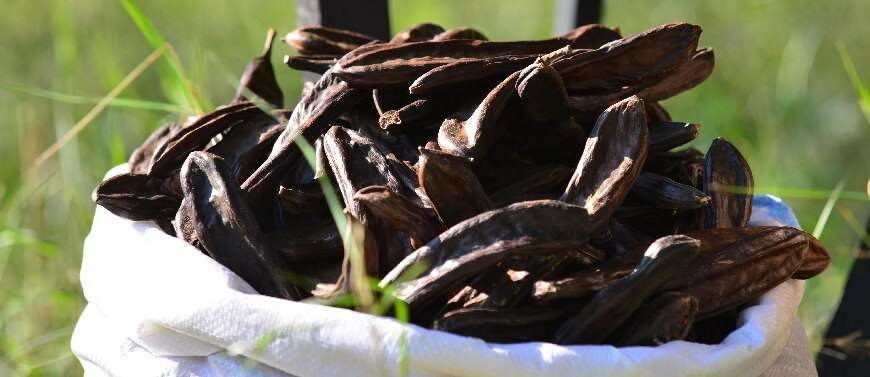
When carob is mentioned, the first thing that usually comes to mind is molasses. Yet in traditional pantry culture, there is a clear principle: “use the whole fruit.” The peel, the pulp, even the seed—nothing goes to waste. Carob also has two lesser-known but genuinely valuable by-products: its seeds and its flour. Today, the food industry uses both for different purposes; and in the home kitchen, if you understand them correctly, they become practical ingredients that add flavor and expand how you can use carob.
This is not about a romantic narrative; it is about solid, useful knowledge. Because just as it is wrong to assume every “natural product” is automatically beneficial, it is equally wrong to dismiss long-established ingredients simply because they are “old.”
What Are Carob Seeds and Why Are They Important?
When you break a carob pod, hard, shiny, small seeds come out. These seeds are the toughest part of the fruit and are not easy to chew directly. In traditional use, the seed is usually separated, because the sweet, enjoyable part is the fleshy section of the pod. But the seed’s real value begins right there.
Within the seed’s structure, an ingredient is obtained that provides texture in foods and is widely used in industry: locust bean gum. This substance is used in many products as a thickener and stabilizer. Here is the key point: what you call “gum” is not the seed itself; it is a product obtained through specific processes from a particular part of the seed.
What Is “Gum” Used For?
Locust bean gum forms viscosity when it comes into contact with water. For this reason, it is used to provide texture and stability in ice cream, yogurt, sauces, soups, milk-based desserts, and gluten-free products. In ice cream, for example, it is discussed for practical benefits such as helping reduce ice crystals and supporting a smoother texture.
In home cooking, direct use of gum is not very common. Still, it is worth knowing, because you may see it on ingredient labels. Let me be clear: not every ingredient you see on a label is automatically “bad.” What matters is what the substance is, why it is used, and in what amount. Traditional common sense does not act on hearsay fear; it acts on knowledge.
How Can Carob Seeds Be Used at Home?
Because of their hardness, home use is limited in practice. Grinding the seeds is difficult; without a strong mill or suitable equipment, turning them into a fine powder is not easy. For this reason, a more realistic approach at home is to separate and store the seeds and to use industrially prepared products consciously and correctly.
Instead of chasing bold claims such as “boil the seed and produce a miracle,” it is more sound to understand the seed’s place in food technology. If food-grade, reliably sourced locust bean gum is available on the market, small trials can be done in low ratios. However, using too much can cause texture defects and an unnecessarily gel-like structure. Measure matters.
What Is Carob Flour?
Carob flour is a dark-colored flour produced by drying and grinding the fleshy part of the carob pod. Its most distinctive feature is its natural sweetness and toasted aroma. This is also why it is sometimes used in place of cocoa. But let’s be plain: carob flour is not cocoa. It does not give the sharp bitterness of cocoa; it offers a softer, caramel-like and malt-like profile.
Because of this character, it can also help reduce added sugar. Used correctly, it creates a “chocolate-like” impression in desserts, but if the goal is “exactly chocolate,” then supporting ingredients are needed.
Kitchen Advantages of Carob Flour
Carob flour adds color, brings aromatic depth, and can reduce the need for sugar in sweet recipes thanks to its natural sweetness. You can get good results in cakes, cookies, pancakes, smoothies, and milk-based mixtures. In some recipes, it can also improve binding.
That said, the “toasted” taste it leaves can feel pleasantly rich to some and too heavy to others. This is simply personal preference. Traditional cooking has always worked this way: not every ingredient suits every palate. Skill is using the ingredient in the right place.
Key Points to Watch When Using Carob Flour
This flour is powerful. If used excessively, it can dominate the flavor and make baked goods feel dense. Practical rule: start with a small amount in your first trials and adjust the recipe accordingly. For example, in a standard cake, replacing a small portion of the main flour with carob flour is a safe starting point.
Also remember that carob flour has its own sweetness, so the sugar level should be reconsidered. If you keep the same amount of sugar and add carob flour on top, the result may become overly sweet. Liquid balance matters too; small adjustments may be required in some recipes.
Practical Ways to Use Carob Flour at Home
The easiest uses at home are yogurt mixtures and hot drinks. Adding a small amount of carob flour to yogurt with a piece of banana increases both sweetness and thickness. Mixed with milk, it gives a “cocoa-like” drink impression; the critical point is to round the aroma with vanilla or a very small amount of cinnamon.
In cookies, carob flour should not be treated as the main flour on its own; think of it more as a supporting character ingredient. It also pairs well with oily ingredients such as tahini and hazelnut spread, because they strengthen mouthfeel.
A Lesser-Known By-Product: Carob Pulp
In molasses production or extraction processes, pulp remains. In traditional kitchens, this pulp was sometimes used as animal feed and sometimes dried and used for other purposes. Today, pulp can be evaluated as a fiber-rich by-product in certain products.
Using pulp at home is more labor-intensive, but it is still worth knowing as part of the “use everything” mindset. In our culture, it was not only the “nice” part of a product that was valued; leftovers were also used. That is both economy and respect.
Why Is It Being Discussed More Today?
Carob flour and seeds are being discussed more today for two reasons. First: the effort to reduce sugar consumption. Carob flour, with its natural sweetness, offers a practical tool here. Second: growing interest in natural texturizers in food technology. The gum obtained from the seed sits at the center of this interest.
In other words, this “rediscovery” is actually an old ingredient being reinterpreted through new needs. That is how traditional products survive: they adapt to new lives without losing their roots.
Carob seeds and carob flour are valuable by-products for those who do not see carob as “only molasses.” The seed is the source of locust bean gum, used especially in the food industry as a texturizer. The flour, in the home kitchen, is a strong ingredient that adds aroma and color to desserts, drinks, and certain baked goods, and can help reduce the need for sugar thanks to its natural sweetness.
The secret to using these products correctly is measurement. If you know what to add and how much, the result will be good. Traditional kitchen logic says the same thing: the ingredient is valuable, but mastery is in the measure.